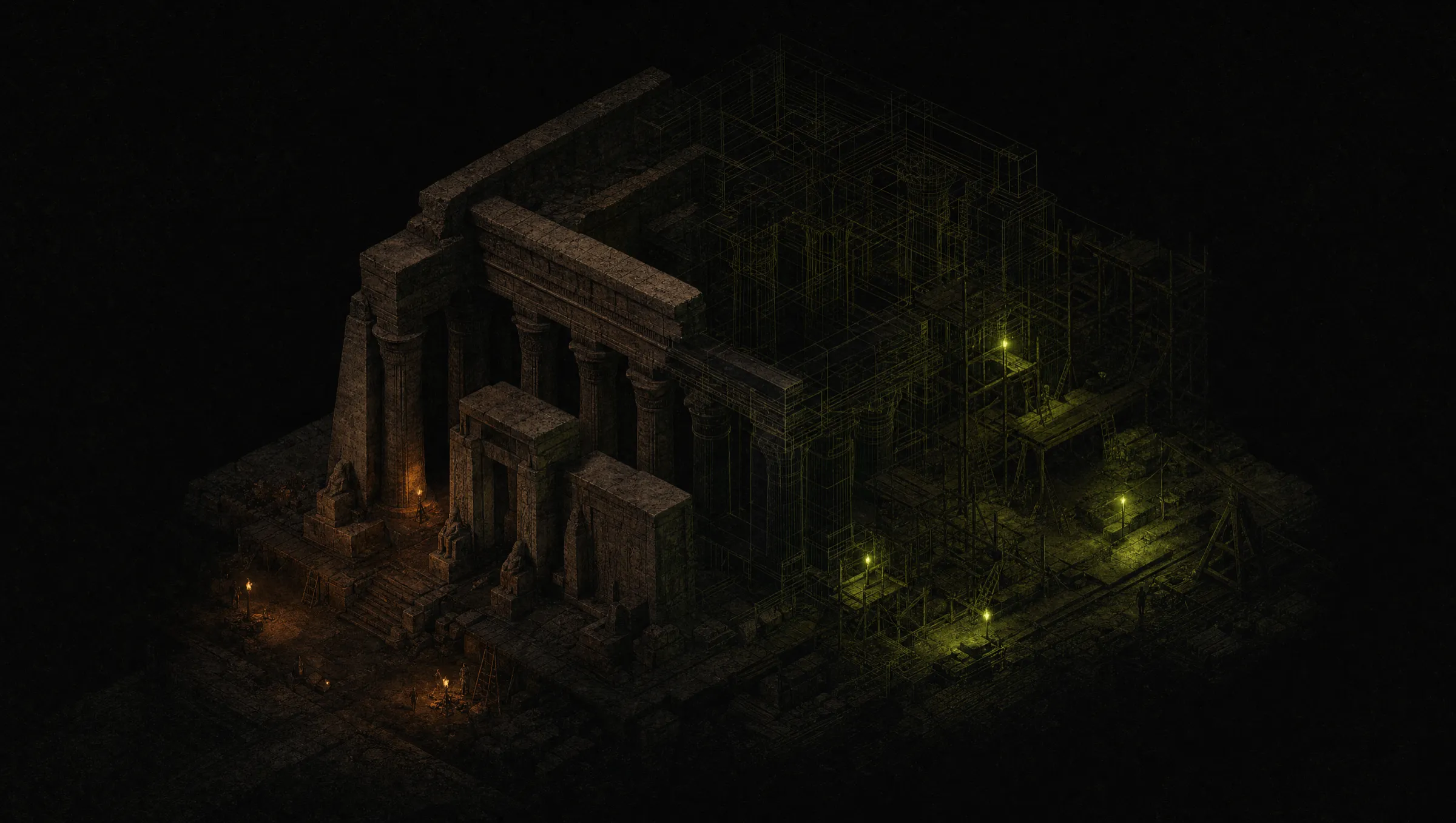
I already wrote the goodbye to Book of Aaru: the studio, the walking away, what a game teaches that a SaaS never will.1 This is the other essay, the one for builders: the post-mortem of the build itself. Five years, Unity and C#, a team between five and eight, one full restart, a Steam release in May 2025 that players liked (86% positive) and that never earned back its years.2 Below is where the time actually went, and what I would never do the same way again.
The restart, and what restarts can’t fix
We started in 2021 as The Book of Thoth. About a year in, our lead designer-developer called it: the assets and the architecture were not good enough to carry the game. So we restarted: new name, new team, new ideas. (There was also an NFT side-experiment around that time; it was a community-building fluke, not the game, and it taught us nothing worth the sentence it just got.) The restart became Aaru, and it took four more years to ship.
Calling the restart was right, and it was brave. A year of work is exactly heavy enough that most teams would have dragged it to the end. But here is the uncomfortable finding of this post-mortem: a restart fixes what you can see. Assets, architecture, the name: the artifacts. It does not touch how you decide, because the deciders walk into the new repo carrying the same instincts. Every expensive mistake below survived the reboot intact.
Where the years went: art
The single biggest allocation error was proportion: too much of the budget (time and money both) went into art, too little into concepts and the design loop underneath them.
The economics of Steam make this mistake close to fatal. The median game earns about $1,136 lifetime (Chris Zukowski’s number from a full-year cohort), and Steam’s own visibility machinery doesn’t meaningfully kick in until roughly the $250,000 mark.3 In 2024 alone, 18,324 games shipped on the platform, and by Zukowski’s benchmark only about 2.4% of them cleared even a modest bar of success.4 In a flood like that, what differentiates a game is the concept: the loop, the feel, the idea a player retells to a friend in one sentence. Art doesn’t create that signal. Art amplifies it. We bought world-class amplification for a signal we were still searching for, and beautiful screenshots of an unfound loop are the most expensive kind of screenshot there is.
The team shape was wrong, twice
For too long, one developer carried the build alone, and eventually he moved on. Near the end, two hungry students joined and finished the last stretch, and the contrast was humiliating in the useful way: the last-stretch pace was the pace the whole project deserved.
The lesson isn’t “hire more people.” It’s about failure modes: a single carrying developer is a single point of failure that fails slowly. You don’t notice the project is resting on one tired person until they fold. Two developers sooner, even part-time, even junior-but-hungry, would have cost less than the year the slow failure ate. Hungry beats senior when the budget is small and the finish line is far.
The ground moved under the build
Two AI stories from the same project, same years.
In 2024 I tried to build TikTok distribution bots: gameplay footage running under organic content about Egypt, Rome, empires (the topics our world borrowed from). The models of that moment weren’t good enough, and I abandoned it before it produced real distribution. Honest verdict: too early, correctly killed.
The second story is bigger. While we hand-built, the ground moved. Somewhere around 2024, iteration got cheap for teams building AI-first, and our whole way of working (mine included) was priced in the old currency. Watching that gap widen month after month made me reconsider the path itself: not just how we were finishing Aaru, but whether starting another game the same way could be justified at all. In a genre (the roguelite) that lives and dies by iteration speed, that reconsideration became one of the strongest forces on the project. You won’t find it in any budget line. It was everywhere.
The restart replaced the assets, the architecture, and the name. It replaced everything except how we decided.
The ending that never got announced
We shipped in May 2025. The people who found the game liked it; 86% positive is a real compliment from strangers.2 Commercially it stayed small. My current plan is to cut the price (€14.79 reads as too high for an unknown studio’s roguelite) or drop it to free, because at this point I want it played more than I want it paid.
And then the studio didn’t end; it just stopped. Nobody called a meeting. The team was tired, nobody wanted to start game two, and AI was improving so fast that hand-building another game felt like the wrong bet even to me. There was never a formal “this is the end.” We just never came back. I used to think that was a failure of leadership. A proper ending deserved a proper announcement. Now I think the missing ceremony was the information: when a project ends by silence, the silence is the team telling you what a survey never would.
The one fix I believe in
Every mistake above has the same root, and the restart is the proof. The restart was a big leap: throw it away, do it right this time. Big leaps feel decisive and they photograph well, but they carry your decision-making across unchanged, and they bet years on the new guess being right.
What I believe in now is the opposite: the 1% loop. Iterate relentlessly on small hypotheses (a concept sketch, a graybox level, a price test, a TikTok clip) where each cycle is cheap enough that being wrong teaches instead of bankrupts. If Thoth had lived inside a 1% loop, the art overspend would have surfaced in months, not years. The core loop would have been found or falsified before the amplification budget existed. The team-shape failure would have shown up as a velocity number instead of a resignation.
I’ll make games again (I can feel it), but AI-first, concepts first, art last, and never again assembling things by hand that a loop could have tested for me. Five years bought me exactly one unshakeable conviction: the teams that ship aren’t the ones that leap beautifully. They’re the ones that never stop taking the next 1%.
Footnotes
-
The personal retro is here: I shipped a game, then walked away. ↩
-
The Book of Aaru on Steam: action isometric roguelite, released May 2025, 86% positive reviews. https://store.steampowered.com/app/2092970/The_Book_of_Aaru/ ↩ ↩2
-
Chris Zukowski, “The median indie game does not earn a whole lot,” How To Market A Game, 28 November 2022. Median lifetime gross $1,136 for the 2019 cohort; Steam front-page consideration starts around $250K. https://howtomarketagame.com/2022/11/28/the-median-indie-game-does-not-earn-a-whole-lot/ ↩
-
“How to Market a Game: Steam in 2024,” GameDev Reports summary of Chris Zukowski’s analysis of VG Insights data: 18,324 releases in 2024, ~2.44% crossing the 1,000-review success bar. https://gamedevreports.substack.com/p/how-to-market-a-game-steam-in-2024 ↩