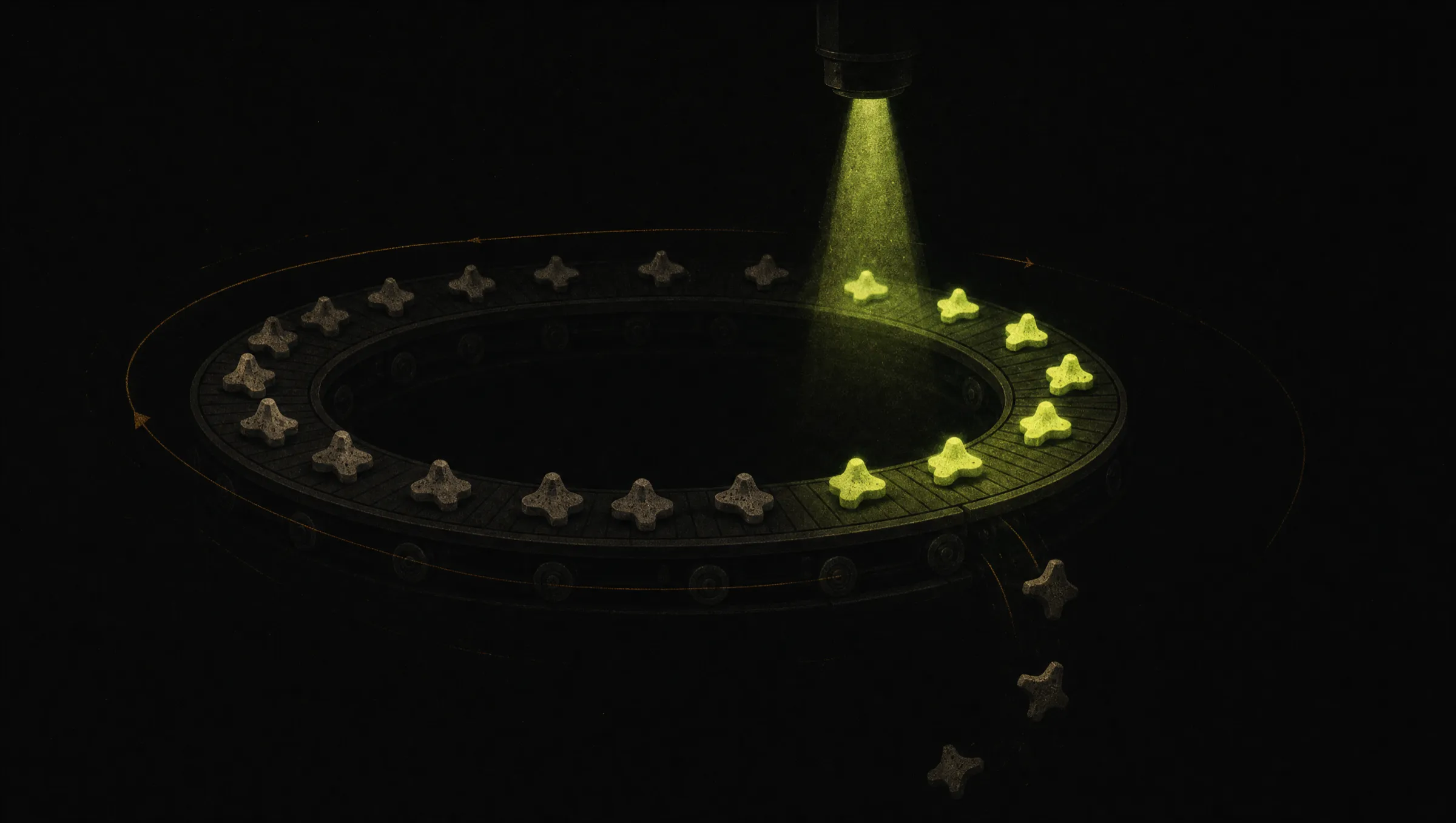
Here is the sentence everyone repeats now, in the same soothing tone, at every conference and in every thread: taste is the one thing AI can’t take from you. The models will write the code, generate the image, draft the copy. But taste, judgment, the eye for what’s good, that stays human. That’s your moat.
I think it’s a cope. Not because taste isn’t real, but because the thing people call taste is not the mysterious, un-automatable gift they need it to be. It is an evaluation function (the thing that tells a feedback loop better from worse), and we have spent the last decade getting very good at fitting exactly that kind of function from human judgment. So let me make the actual case, including the strongest version of the argument against me, and the one place the story holds.
The thing everyone is quietly afraid of
The claim is everywhere, and it’s coming from people who are not naive. Sam Altman, hiring for the frontier, says the best teams are built “through context, taste and a real feel for where the field is headed next.”1 The VC version is blunter: “What separates people now isn’t access, but judgment,”2 and “a competitor can copy your features in a weekend now… but they can’t copy your judgment.”3 Paul Graham’s Taste for Makers, the essay all of this descends from, insists taste is not just personal preference, that “poof goes the axiom that taste can’t be wrong.”4
Notice what the comfort depends on: taste has to be inarticulable. If you could write down what makes one thing better than another, you could hand that specification to a machine. The whole reassurance rests on the belief that you can’t. That the good stuff lives somewhere below language, in a place a model can’t follow.
The steelman: we know more than we can tell
This is a real idea, and it has a serious name behind it. In 1966 Michael Polanyi opened The Tacit Dimension with the line the whole field turns on: “we can know more than we can tell.”5 The expert radiologist who spots the tumor, the potter who feels when the clay is right, the editor who knows the sentence is wrong before knowing why. They have the knowledge and cannot fully export it. Connoisseurship, Polanyi argued, is passed by apprenticeship and example, not by rule, precisely because the rules can’t be stated.
If taste is tacit in that strong sense, the cope is correct. You cannot specify it, so you cannot optimize it, so it stays yours. That’s the argument at its best, and I want to give it its full weight before I take it apart: most of what we call taste genuinely cannot be written down as rules. I can’t hand you the spec for a good interface any more than Polanyi’s radiologist can hand you the spec for a tumor.
But “can’t be written as rules” and “can’t be learned” are not the same claim. And the entire modern AI stack is built on the gap between them.
Strip the mystique: taste is an evaluation function
This is the reframe the comfort story needs you not to make.
You do not need to articulate taste to use it. You only need to be able to look at two things and say which is better. That’s it. That single, humble act (ranking A above B) is a signal. And a signal is all a learning system has ever needed.
This is not a metaphor. It is, almost exactly, how modern models are trained to be good.
We already built the machine that learns it
In 2017, Christiano and colleagues showed you could teach a system a goal nobody wrote down: purely from a human looking at pairs of behaviors and picking the better one. They fit a reward model to those comparisons “while providing feedback on less than one percent of our agent’s interactions.”6 A person who couldn’t code the objective could still point at better, and that pointing was enough to learn the objective.
That technique, reinforcement learning from human feedback, is how the assistants you use every day were shaped. Anthropic’s own foundational paper describes it plainly: “we apply preference modeling and reinforcement learning from human feedback to finetune language models.”7 The formal name for the fitted taste is a preference model. Then in 2023, Direct Preference Optimization made the punchline unavoidable: your language model, the paper argued, “is secretly a reward model.”8 The judge and the maker are not even separate objects. The taste is baked into the thing that produces the work.
Read those three papers back to back and the mystique quietly dies. The entire pipeline is: humans express preference between outputs → a function is fit to that preference → the model optimizes against the function. That is taste, operationalized, at industrial scale. Nobody had to articulate the rule. They only had to keep choosing the better of two things: the exact move the cope insists is uniquely, permanently human.
And the models are starting to run the loop themselves
If it stopped there, you could still argue humans are the irreplaceable source of the preference. But that’s already eroding.
Anthropic’s Constitutional AI trained a model “through self-improvement, without any human labels identifying harmful outputs”. The AI generates its own feedback and learns from it.9 In image generation, the LAION-Aesthetics predictor is a literal taste model: a network trained to guess “how much do you like this image, 1 to 10,” then used to filter the data that Stable Diffusion learned from.10 A machine’s aesthetic judgment shaped what the generator finds beautiful. And when you ask whether models can judge quality the way we do, the answer is uncomfortable: strong LLM judges “can match both controlled and crowdsourced human preferences well, achieving over 80% agreement, the same level of agreement between humans.”11
And it shows up in the output. In a 2024 study of over 1,600 readers, AI-generated poetry was not just mistaken for human work. It was preferred, rated higher on rhythm and beauty, and that very quality is part of why people misattributed it.12 By 2026 there are papers whose entire project is “deconstructing taste”: taking the thing everyone calls ineffable and linking it to concrete, machine-extractable features so it can be modeled.13 The research community is not treating taste as sacred. It is treating it as a target.
Taste was never a gift you have. It's a function you fit, and we built the machines that fit it.
The one place the story holds, and why it doesn’t save the cope
Now the honest part, because there is real evidence on the other side and I’d be doing the same thing I’m criticizing if I hid it.
Run the loop naively and it eats itself. Train models on their own output across generations and you get model collapse: “a degenerative process” where “tails of the original content distribution disappear.”14 Give a room full of writers the same AI assistant and, as a controlled experiment with hundreds of authors found, each individual story gets rated more creative, but “generative AI–enabled stories are more similar to each other than stories by humans alone.”15 The loop lifts the floor and flattens the ceiling. It converges toward a competent, agreeable average. Even the taste models carry their makers’ bias forward: an audit of LAION-Aesthetics found it systematically filtered images by who was in them.16
This is the strongest evidence that something human still matters. But look at what it says. It is not “taste can’t be fitted.” It’s “a loop with no fresh outside signal decays toward the mean.” Those are completely different claims. The homogenization is what happens when the loop has nothing new to rank against, when it’s grading its own homework. It’s an argument about who feeds the loop and how, not about whether the loop can learn.
So taste stops being a noun and becomes a verb
Put it together and the human edge is real, but it is not the one the cope promised. It is not an ineffable gift that makes you un-automatable while you sit still. It is a job: be the source of signal the loop can’t generate for itself, and be the one who runs the loop, who decides what to rank, in which direction, against what standard, and how fast.
Taste, in other words, stops being a thing you have and becomes a thing you do. The person who wins is not the one with the most refined palate held in quiet reserve. It’s the one who can say this beats that, and here’s the direction clearly and quickly enough to steer a system that is already, demonstrably, learning to judge, and who keeps pumping new signal into the loop faster than it flattens. That’s a skill. It compounds. It also looks nothing like the serene, protected connoisseurship people are counting on.
And that is exactly why “taste is the one thing they can’t take” is a dangerous thing to believe. It tells you to stop working on the one capability that’s actually appreciating. It reframes a muscle as a birthmark. The people repeating it as reassurance are, without meaning to, talking themselves out of training the thing that matters most.
I’d rather treat my taste as a function I can measure, sharpen, and partly delegate than as a charm that keeps me safe. The charm story feels better. It’s also the story you tell right before the loop laps you. Strip the mystique. It was never magic. It was a feedback loop, and feedback loops are learnable. The only question left worth asking is who’s running yours.
Footnotes
-
Sam Altman, quoted in “Have good taste? It may just get you a job during the AI jobs apocalypse, says Sam Altman,” Fortune, 27 February 2026. https://fortune.com/2026/02/27/openai-sam-altman-taste-get-jobseekers-hired-ai-jobpocalypse/ ↩
-
Jack Arenas, “Taste is the Moat,” Founder Collective, 1 May 2025. https://foundercollective.com/blog/taste-is-the-moat/ ↩
-
Andrés Max, “Taste Is the New Moat,” andresmax.com, 27 March 2026. https://andresmax.com/taste-is-the-new-moat/ ↩
-
Paul Graham, “Taste for Makers,” February 2002. https://paulgraham.com/taste.html ↩
-
Michael Polanyi, The Tacit Dimension, University of Chicago Press, 1966 (opening chapter). https://press.uchicago.edu/ucp/books/book/chicago/T/bo6035368.html ↩
-
Paul Christiano, Jan Leike, Tom Brown, Miljan Martic, Shane Legg, Dario Amodei, “Deep Reinforcement Learning from Human Preferences,” NeurIPS 2017. https://arxiv.org/abs/1706.03741 ↩
-
Yuntao Bai et al., “Training a Helpful and Harmless Assistant with Reinforcement Learning from Human Feedback,” Anthropic, 2022. https://arxiv.org/abs/2204.05862 ↩
-
Rafael Rafailov, Archit Sharma, Eric Mitchell, Stefano Ermon, Christopher D. Manning, Chelsea Finn, “Direct Preference Optimization: Your Language Model is Secretly a Reward Model,” NeurIPS 2023. https://arxiv.org/abs/2305.18290 ↩
-
Yuntao Bai et al., “Constitutional AI: Harmlessness from AI Feedback,” Anthropic, 2022. https://arxiv.org/abs/2212.08073 ↩
-
LAION, “LAION-Aesthetics,” 16 August 2022. https://laion.ai/blog/laion-aesthetics/ ↩
-
Lianmin Zheng et al., “Judging LLM-as-a-Judge with MT-Bench and Chatbot Arena,” NeurIPS 2023. https://arxiv.org/abs/2306.05685 ↩
-
Brian Porter, Edouard Machery, “AI-generated poetry is indistinguishable from human-written poetry and is rated more favorably,” Scientific Reports 14:26133, November 2024. https://www.nature.com/articles/s41598-024-76900-1 ↩
-
Y. Hong et al., “Deconstructing Taste: Toward a Human-Centered AI Framework for Modeling Consumer Aesthetic Perceptions,” January 2026. https://arxiv.org/abs/2601.17134 ↩
-
Ilia Shumailov, Zakhar Shumaylov, Yiren Zhao, Nicolas Papernot, Ross Anderson, Yarin Gal, “AI models collapse when trained on recursively generated data,” Nature 631, 755–759, July 2024. https://www.nature.com/articles/s41586-024-07566-y ↩
-
Anil R. Doshi, Oliver P. Hauser, “Generative AI enhances individual creativity but reduces the collective diversity of novel content,” Science Advances, 14 June 2024. https://www.science.org/doi/10.1126/sciadv.adn5290 ↩
-
“The Algorithmic Gaze of Image Quality Assessment: An Audit and Trace Ethnography of the LAION-Aesthetics Predictor,” 2026. https://arxiv.org/abs/2601.09896 ↩